Constraint
ReHLine allows you to impose various linear constraints on the model coefficients.
Usage Pattern
Define constraints as a list of dictionaries:
# list of constraint dictionaries
constraint = [{'name': <constraint_name>, **kwargs}, ...]
Supported Constraints
Non-negative
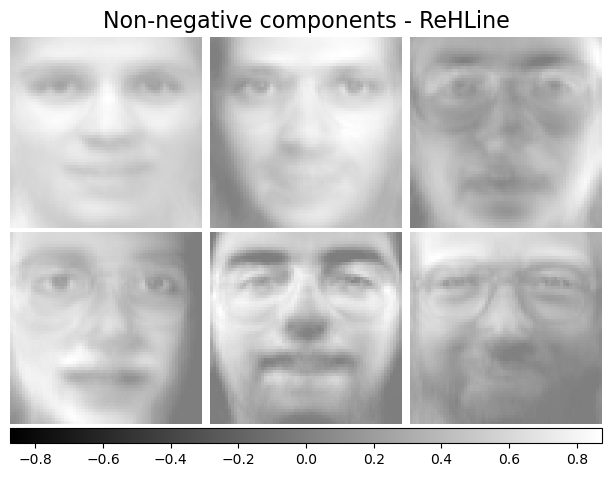
Constrains all coefficients to be non-negative (\(\beta_j \ge 0\)) [1].
Names:
'nonnegative','>=0'Parameters: None
constraint = [{'name': '>=0'}]
Related Example
Fairness
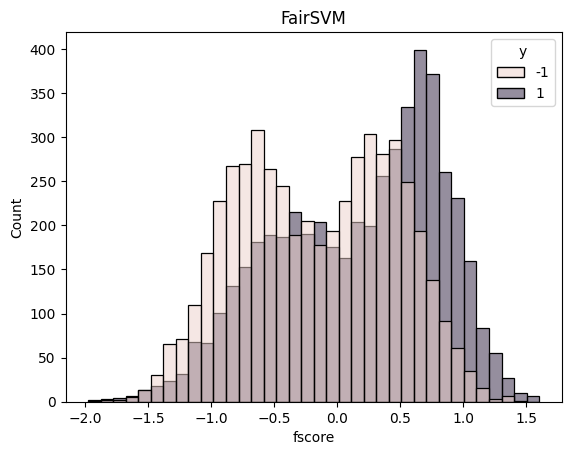
Constrains the correlation between predictions and sensitive attributes to be within a tolerance [2].
Names:
'fair','fairness'- Parameters:
sen_idx(list of int): Column indices of sensitive attributes inX.tol_sen(list of float): Tolerance thresholds for each sensitive attribute.
# Example: Constrain fairness w.r.t. feature at index 0 with tolerance 0.01
constraint = [{'name': 'fair', 'sen_idx': [0], 'tol_sen': [0.01]}]
Related Example
Monotonicity
Constrains coefficients to be monotonically increasing or decreasing [3]. Increasing: \(\beta_i \le \beta_{i+1}\). Decreasing: \(\beta_i \ge \beta_{i+1}\).
Names:
'monotonic','monotonicity'- Parameters:
decreasing(bool, default=False): IfTrue, enforces decreasing monotonicity.
# Monotonically increasing
constraint = [{'name': 'monotonic'}]

# Monotonically decreasing
constraint = [{'name': 'monotonic', 'decreasing': True}]
Custom Constraints
Define arbitrary linear constraints of the form \(A\beta + b \ge 0\).
Names:
'custom'- Parameters:
A(ndarray): Coefficient matrix of shape (K, d).b(ndarray): Intercept vector of shape (K,).
import numpy as np

# Example: beta_0 + beta_1 >= 1
A = np.zeros((1, d))
A[0, 0] = 1
A[0, 1] = 1
b = np.array([-1.0])

constraint = [{'name': 'custom', 'A': A, 'b': b}]