Non-negative Matrix Factorization (NMF)

Non-negative Matrix Factorizaation (NMF) solves the following optimiation problem:
where
\(\phi(\cdot , \cdot)\) is a convex piecewise linear-quadratic loss function
\(\Omega\) is a user-item collection that records all training data
\(n\) is number of rows in target matrix, \(m\) is number of columns in target matrix
\(k\) is length of latent factors (rank of MF)
\(C\) is regularization parameter, \(\rho\) balances regularization strength between user and item
\(\mathbf{p}_u\) and \(\alpha_u\) are latent vector and individual bias of u-th row. Specifically, \(\mathbf{p}_u\) is the u-th row of \(\mathbf{P}\), and \(\alpha_u\) is the u-th element of \(\pmb{\alpha}\)
\(\mathbf{q}_i\) and \(\beta_i\) are latent vector and individual bias of i-th column. Specifically, \(\mathbf{q}_i\) is the i-th row of \(\mathbf{Q}\), and \(\beta_i\) is the i-th element of \(\pmb{\beta}\)
[1]:
## packages
import matplotlib.pyplot as plt
import numpy as np
from numpy.random import RandomState
from sklearn.datasets import fetch_olivetti_faces

from rehline import plqMF_Ridge
[2]:
## set random state
rng = RandomState(0)


## import face data and convert to triplet dataset
faces, _ = fetch_olivetti_faces(return_X_y=True, shuffle=True, random_state=rng)
n_samples, n_features = faces.shape

rows, cols = np.nonzero(faces)
X = np.column_stack((rows, cols))
y = faces[rows, cols]


## define a face-visualization function
n_row, n_col = 2, 3
n_components = n_row * n_col
image_shape = (64, 64)


def plot_gallery(title, images, n_col=n_col, n_row=n_row, cmap=plt.cm.gray):
    fig, axs = plt.subplots(
        nrows=n_row,
        ncols=n_col,
        figsize=(2.0 * n_col, 2.3 * n_row),
        facecolor="white",
        constrained_layout=True,
    )
    fig.set_constrained_layout_pads(w_pad=0.01, h_pad=0.02, hspace=0, wspace=0)
    fig.set_edgecolor("black")
    fig.suptitle(title, size=16)
    for ax, vec in zip(axs.flat, images):
        vmax = max(vec.max(), -vec.min())
        im = ax.imshow(
            vec.reshape(image_shape),
            cmap=cmap,
            interpolation="nearest",
            vmin=-vmax,
            vmax=vmax,
        )
        ax.axis("off")

    fig.colorbar(im, ax=axs, orientation="horizontal", shrink=0.99, aspect=40, pad=0.01)
    plt.show()


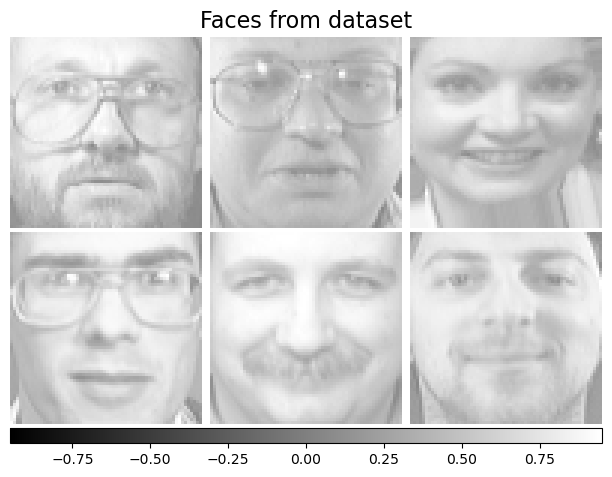
## show some faces
plot_gallery("Faces from dataset", faces[:n_components])
[3]:
## solve nmf via rehline
nmf_rehline = plqMF_Ridge(
    C=0.0003,
    biased=False,
    n_users=n_samples,
    n_items=n_features,
    rank=n_components,
    loss={"name": "mse"},
    constraint_user=[{"name": ">=0"}],
    constraint_item=[{"name": ">=0"}],
    verbose=1,
    max_iter_CD=5,
    random_state=0,
    tol=0.01,
)

nmf_rehline.fit(X, y)
Iteration    Average Loss(mse)    Objective Function
1            0.020348             18.630042
2            0.012533             12.627574
3            0.010705             10.203743
4            0.009903             8.819946
5            0.009485             7.921505
[3]:
plqMF_Ridge(C=0.0003, biased=False, constraint_item=[{'name': '>=0'}],
            constraint_user=[{'name': '>=0'}], loss={'name': 'mse'},
            max_iter_CD=5, n_items=4096, n_users=400, random_state=0, rank=6,
            tol=0.01, verbose=1)
In a Jupyter environment, please rerun this cell to show the HTML representation or trust the notebook. On GitHub, the HTML representation is unable to render, please try loading this page with nbviewer.org.
Parameters
| n_users | 400 | |
| n_items | 4096 | |
| loss | {'name': 'mse'} | |
| biased | False | |
| constraint_user | [{'name': '>=0'}] | |
| constraint_item | [{'name': '>=0'}] | |
| rank | 6 | |
| C | 0.0003 | |
| rho | 0.5 | |
| init_mean | 0.0 | |
| init_sd | 0.1 | |
| random_state | 0 | |
| max_iter | 10000 | |
| tol | 0.01 | |
| shrink | 1 | |
| trace_freq | 100 | |
| max_iter_CD | 5 | |
| tol_CD | 0.0001 | |
| verbose | 1 |
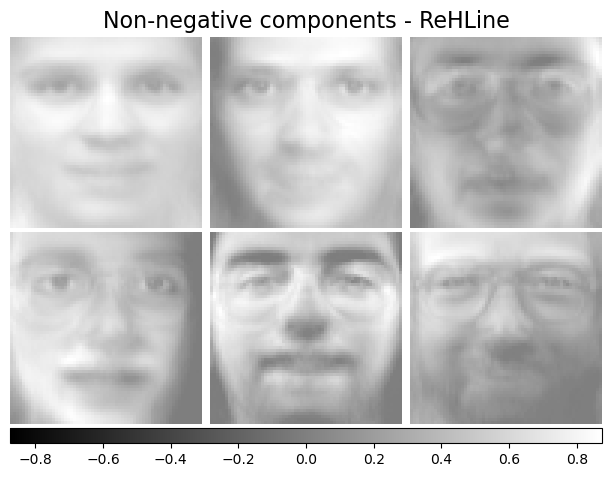
[4]:
## check eigen faces
plot_gallery("Non-negative components - ReHLine", np.transpose(nmf_rehline.Q))