Huber Regression

The regularized Huber regression solves the following optimization problem:
\[\min_{\beta \in \mathbb{R}^d}
C \sum_{i=1}^n H_{\tau}(y_i - x_i^\top \beta)
+ \frac{\lambda}{2}\|\beta\|_2^2,\]
where \(H_{\tau}(\cdot)\) is the Huber loss with parameter \(\tau\):
\[\begin{split}H_{\tau}(z)=
\begin{cases}
\frac{z^2}{2}, & |z| \le \tau, \\
\tau\left(|z|-\frac{\tau}{2}\right), & |z| > \tau.
\end{cases}\end{split}\]
Note. Since the Huber loss is a plq function, we can optimize it using
rehline.plq_Ridge_Regressor. Moreover, this wrapper adapts theplqERM_Ridgeinto a regressor, compatible with the scikit-learn API.
[ ]:
## install rehline
%pip install rehline -q
[2]:
import warnings

import matplotlib.pyplot as plt
import numpy as np
import pandas as pd
import seaborn as sns
from sklearn.datasets import make_regression
from sklearn.preprocessing import StandardScaler
[3]:
## simulate data
np.random.seed(42)
scaler_huber = StandardScaler()

n, d = 10000, 5
X, y = make_regression(n_samples=n, n_features=d, noise=10.0)
X = scaler_huber.fit_transform(X)
y = y / y.std()
[4]:
## solve Huber Regression with different `tau` via `plq_Ridge_Regressor`
from rehline import plq_Ridge_Regressor

clf_tau01 = plq_Ridge_Regressor(loss={"name": "huber", "tau": 0.1}, C=10.0 / n)
clf_tau01.fit(X=X, y=y)
clf_tau5 = plq_Ridge_Regressor(loss={"name": "huber", "tau": 5.0}, C=10.0 / n)
clf_tau5.fit(X=X, y=y)
[4]:
plq_Ridge_Regressor(C=0.001, loss={'name': 'huber', 'tau': 5.0})In a Jupyter environment, please rerun this cell to show the HTML representation or trust the notebook. On GitHub, the HTML representation is unable to render, please try loading this page with nbviewer.org.
plq_Ridge_Regressor(C=0.001, loss={'name': 'huber', 'tau': 5.0})[5]:
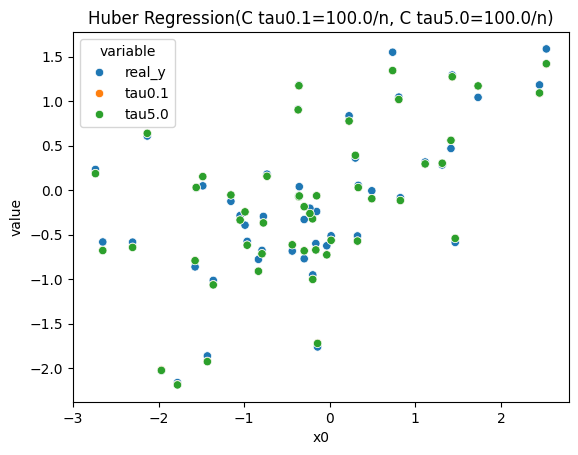
## plot Huber Regression results
warnings.filterwarnings("ignore", "is_categorical_dtype")

n_sample = 50
X_sample, y_sample = X[:n_sample], y[:n_sample]
tau01_sample = clf_tau01.predict(X_sample)
tau5_sample = clf_tau5.predict(X_sample)

df = pd.DataFrame({"x0": X_sample[:, 0], "real_y": y_sample, "tau0.1": tau01_sample, "tau5.0": tau5_sample})
df = df.melt(id_vars="x0")

sns.scatterplot(data=df, x="x0", y="value", hue="variable")
plt.show()

With Pipeline
plq_Ridge_Regressor can be integrated into a scikit-learn Pipeline to streamline preprocessing including scaling.
[6]:
import warnings

import matplotlib.pyplot as plt
import numpy as np
import pandas as pd
import seaborn as sns
from sklearn.datasets import make_regression
from sklearn.pipeline import Pipeline
from sklearn.preprocessing import StandardScaler
[7]:
## simulate data
np.random.seed(42)

n, d = 10000, 5
X, y = make_regression(n_samples=n, n_features=d, noise=10.0)
y = y / y.std()
[8]:
## solve Huber Regression with different 'tau' via 'plq_Ridge_Regressor'
from rehline import plq_Ridge_Regressor

pipe_tau01 = Pipeline(
    [("scaler", StandardScaler()), ("reg", plq_Ridge_Regressor(loss={"name": "huber", "tau": 0.1}, C=10.0 / n))]
)
pipe_tau01.fit(X, y)

pipe_tau5 = Pipeline(
    [("scaler", StandardScaler()), ("reg", plq_Ridge_Regressor(loss={"name": "huber", "tau": 5.0}, C=10.0 / n))]
)
pipe_tau5.fit(X, y)
[8]:
Pipeline(steps=[('scaler', StandardScaler()),
                ('reg',
                 plq_Ridge_Regressor(C=0.001,
                                     loss={'name': 'huber', 'tau': 5.0}))])
In a Jupyter environment, please rerun this cell to show the HTML representation or trust the notebook. On GitHub, the HTML representation is unable to render, please try loading this page with nbviewer.org.
Pipeline(steps=[('scaler', StandardScaler()),
                ('reg',
                 plq_Ridge_Regressor(C=0.001,
loss={'name': 'huber', 'tau': 5.0}))])StandardScaler()
plq_Ridge_Regressor(C=0.001, loss={'name': 'huber', 'tau': 5.0})[9]:
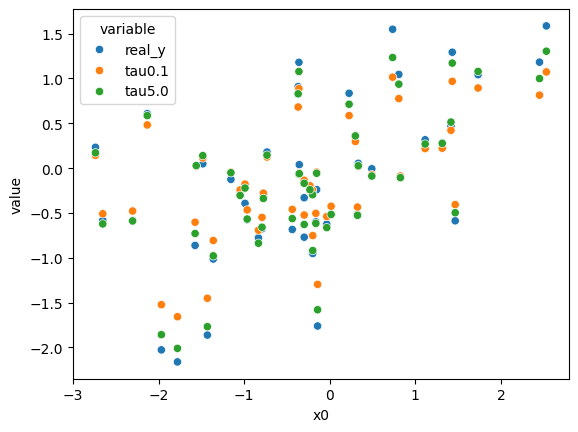
## plot Huber Regression results
warnings.filterwarnings("ignore", "is_categorical_dtype")

n_sample = 50
X_sample, y_sample = X[:n_sample], y[:n_sample]
tau01_sample = pipe_tau01.predict(X_sample)
tau5_sample = pipe_tau5.predict(X_sample)

df = pd.DataFrame({"x0": X_sample[:, 0], "real_y": y_sample, "tau0.1": tau01_sample, "tau5.0": tau5_sample})
df = df.melt(id_vars="x0")

sns.scatterplot(data=df, x="x0", y="value", hue="variable")
plt.show()
Hyperparameter Tuning with GridSearchCV
Due to its compatibility with the scikit-learn API, GridSearchCV can be applied to determine the optimal hyperparameters for the ReHLine model.
[ ]:
import warnings

from sklearn.metrics import make_scorer, mean_squared_error
from sklearn.model_selection import GridSearchCV

warnings.filterwarnings("ignore")

# Define the parameter grid to search
param_grid = {"reg__C": [1.0 / n, 10.0 / n, 100.0 / n]}

# Use mse to evaluate the performances
mse_scorer = make_scorer(mean_squared_error, greater_is_better=False)

# Create the GridSearchCV objects
grid_tau01 = GridSearchCV(pipe_tau01, param_grid, cv=5, scoring=mse_scorer)
grid_tau5 = GridSearchCV(pipe_tau5, param_grid, cv=5, scoring=mse_scorer)

grid_tau01.fit(X, y)
grid_tau5.fit(X, y)

# Print the best parameters and scores
print(f"Best Parameters (tau=0.1): {grid_tau01.best_params_}")
print(f"Best CV Score (tau=0.1): {-grid_tau01.best_score_:.4f}")

print(f"Best Parameters (tau=5.0): {grid_tau5.best_params_}")
print(f"Best CV Score (tau=5.0): {-grid_tau5.best_score_:.4f}")
Best Parameters (tau=0.1): {'reg__C': 0.01}
Best CV Score (tau=0.1): 0.0057
Best Parameters (tau=5.0): {'reg__C': 0.01}
Best CV Score (tau=5.0): 0.0056
[11]:
## plot Huber Regression results
warnings.filterwarnings("ignore", "is_categorical_dtype")

n_sample = 50
X_sample, y_sample = X[:n_sample], y[:n_sample]
tau01_sample = grid_tau01.predict(X_sample)
tau5_sample = grid_tau5.predict(X_sample)

df = pd.DataFrame({"x0": X_sample[:, 0], "real_y": y_sample, "tau0.1": tau01_sample, "tau5.0": tau5_sample})
df = df.melt(id_vars="x0")

sns.scatterplot(data=df, x="x0", y="value", hue="variable").set_title(
    "Huber Regression(C tau0.1=100.0/n, C tau5.0=100.0/n)"
)
plt.show()